TetraPak Printmaking, Drypoint or Collagraph?
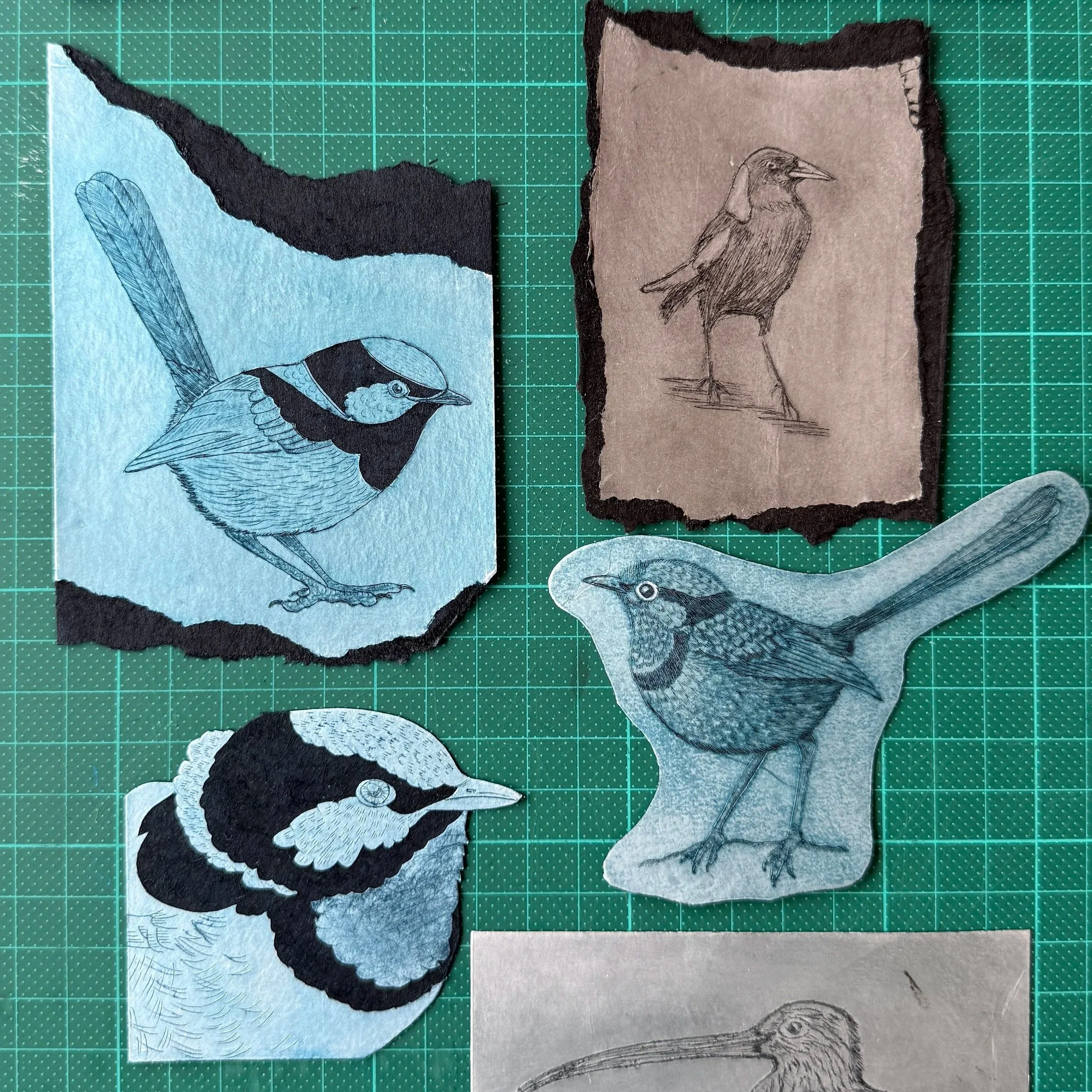
One question I get asked a lot is: what kind of printmaking is TetraPak printmaking? What should you actually call it?
And the slightly annoying answer is: TetraPak is not really the technique. It is the matrix.
In printmaking, the matrix is the surface that holds the image and transfers it to paper. That might be a copper plate, a zinc plate, a lino block, a woodblock, acetate, cardboard, or in this case, a recycled TetraPak carton. The material matters, but it is not always the technique itself.
For example, drypoint is a technique. It involves drawing or scratching into a plate with a sharp tool, creating grooves and burrs that hold ink. Traditionally this might be done on copper or zinc, but it can also be done on other surfaces. So if I take a flat piece of TetraPak and scratch a drawing into it with an etching needle, then ink and print it; I would describe that as “drypoint on TetraPak”.
Where it gets more interesting is when the surface of the TetraPak becomes part of the image. When I peel back layers, use folds, create texture, or let the material itself hold ink in different ways, I’m moving into collagraph territory. Collagraphs are generally made from textured or built-up plates, where the surface qualities of the matrix help create the image.
So for my own work, I usually describe these prints as collagraphs, with TetraPak in brackets. Sometimes I’ll also mention drypoint if scratched linework is a major part of the image. Most of my prints combine both: the drawn drypoint lines, the peeled and textured areas and the accidental marks of the carton.
They all sit broadly under intaglio, because the plate is inked, wiped back, and printed under pressure so the ink is transferred from the incised or textured areas.
So no, TetraPak is not a printmaking technique in the same way that etching, drypoint, linocut or collagraph are techniques. It is an unconventional matrix. A very interesting, surprisingly versatile one, but still a matrix.
That is why I tend to label my work as:
Collagraph (TetraPak)
or
Drypoint (TetraPak)
or
Collagraph, Drypoint (TetraPak)
depending on how the plate has been made.
I do think the TetraPak part is worth mentioning, because it is part of what makes the work interesting. It tells you something about the material, the process, and the environmental thinking behind the work. But technically, the process still needs to be named by what is done to the plate, not just what the plate is made from.
So that’s my position: TetraPak is the matrix. Drypoint and collagraph are the techniques. And in my case, most of my TetraPak prints are best described as TetraPak collagraphs.
Love,
Negin Maddock
@negindesigns