Why I’m Stepping Away from Editions (Mostly)
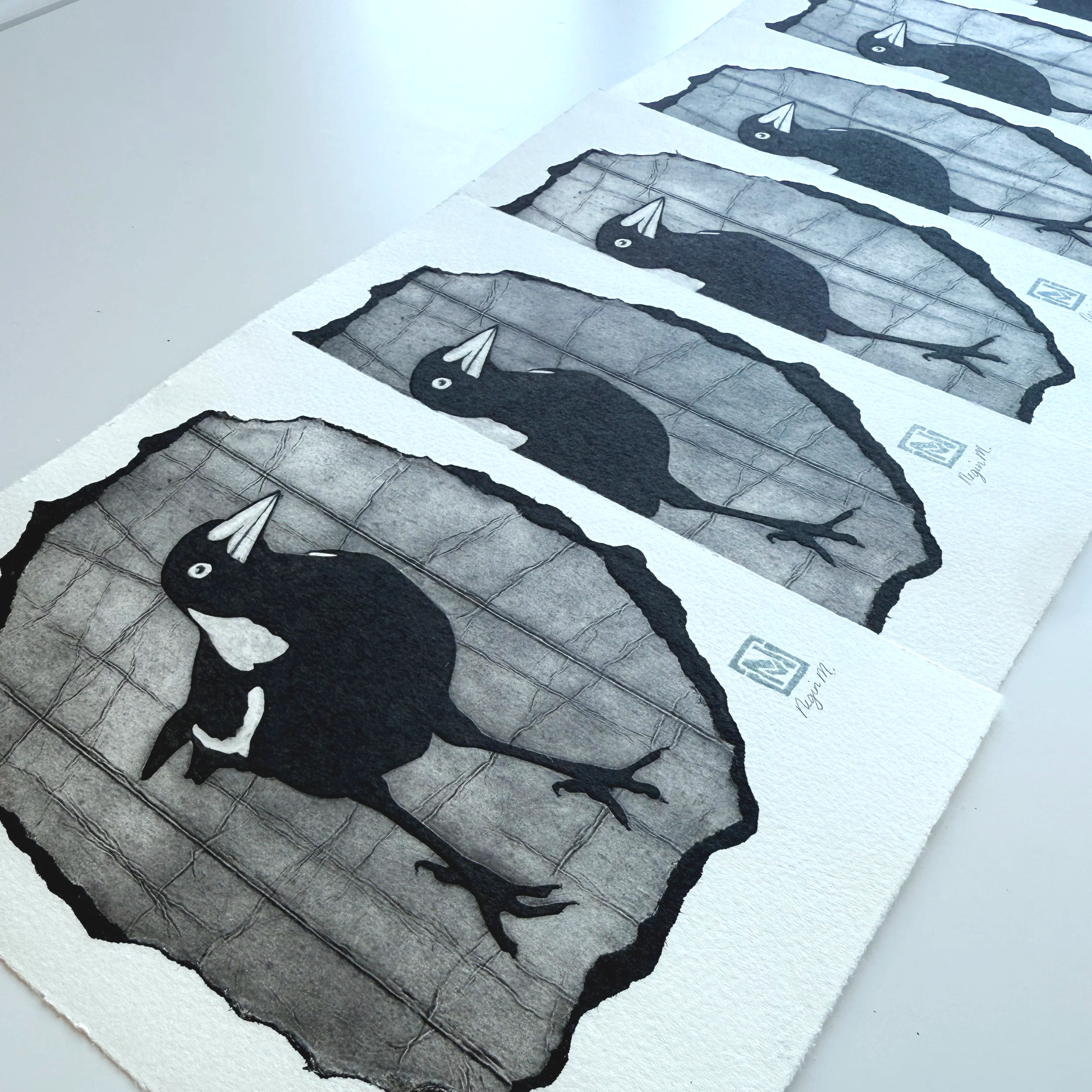
If you’re familiar with printmaking, you’ve probably heard the term “edition.” Traditionally, prints are made in a set number; say an edition of 10 or 20, and each print is numbered accordingly. It’s a long-standing convention in printmaking, tied to ideas of scarcity and collectability.
But here’s the thing; it is a convention. Not a rule. There are no printmaking police turning up to check your numbering system. If you print a few today, sell them, and come back to the plate months later to print more, you absolutely can, as long as you haven’t promised a fixed edition.
Lately, I’ve been rethinking how I approach this in my own practice. I’m not an artist represented by a major gallery, and I’m not working at a scale where limiting my work serves me. What I am doing is trying to build a sustainable creative business. And that means, quite practically, making work available when people connect with it.
If I have a plate that’s still in good condition, why wouldn’t I print from it again? Maybe the ink is slightly different, maybe the paper changes, maybe the tone shifts a little; that’s part of the nature of hand-pulled prints anyway. Each one still carries the marks of the process.
So rather than locking myself into strict editions, I’m choosing flexibility. If a print resonates with people, I want to be able to keep making it available, whether that’s now, in a few months, or next year.
Printmaking is full of tradition, and there’s a lot to respect in that. But it’s also a living practice, and I think there’s room to question which parts still make sense, especially for artists working outside of the traditional gallery system.
For me, this shift is about keeping things sustainable, both creatively and financially, and giving the work the chance to keep finding its way into the world.
Love,
Negin Maddock
@negindesigns